

Buying a mobile phone looks simple. You choose the phone, pay the price, put in your SIM, and start using it. But in Pakistan, there is one more important step that many people forget.
That step is PTA registration.
If your phone is not PTA approved, it may work for some time, but later it can stop working on Pakistani mobile networks like Jazz, Zong, Telenor, and Ufone. This usually happens when the phone’s IMEI is not registered in Pakistan’s official mobile device system.
Many people call it “PTA tax.” In simple words, it means the tax and duty you pay so your mobile phone can legally work in Pakistan. However, it is important to understand one thing clearly: PTA manages the registration system, but the tax is calculated and collected by FBR.
Let’s understand this step by step.
What is DIRBS?
Full form of DIRBS is Device Identification, Registration, and Blocking System.
It is difficult to pronounce the complete name. But let’s make it simple.
Think of DIRBS like a school gatekeeper. The gatekeeper checks which student is allowed to enter the school. In the same way, DIRBS checks which mobile phone is allowed to work on Pakistani mobile networks.
Every mobile phone has a special number called an IMEI number. You can think of it like the phone’s identity card number. No two proper phones should have the same IMEI.
PTA uses DIRBS to check whether a phone is:
legally imported,
properly registered,
tax paid,
or blocked/unregistered.
If the phone is not registered, it may be blocked after the allowed time.
What Happens When You Bring a Phone from Abroad?
If someone brings a phone from another country and puts a Pakistani SIM in it, the phone does not get blocked immediately.
Usually, the system gives the phone a temporary working period. This means the phone can work for a limited time, but it still needs registration if you want to use it permanently in Pakistan.
There are two common situations:
1. Short Visit to Pakistan
If you are an overseas Pakistani or international traveler and you are visiting Pakistan for a short time, PTA gives a temporary registration option.
This may allow your phone to work for up to 120 days without paying tax. This is useful for people who are only visiting and will leave Pakistan again.
2. Permanent Use in Pakistan
If you want to keep using the phone in Pakistan after the allowed period, then you need to register it properly and pay the required FBR duty and taxes.
If you do not do this, the phone’s IMEI may be blocked. After that, the phone may still turn on, connect to Wi-Fi, and open apps, but it will not work properly with a Pakistani SIM.
Passport Registration and CNIC Registration
When you register a mobile phone in Pakistan, the tax can be different depending on how you register it.
The two common methods are:
Passport-based registration
CNIC-based registration
Let’s explain both in simple words.
Passport-Based Registration
Passport registration is mainly for international travelers.
For example, suppose you came to Pakistan from another country and brought your mobile phone with you. If you register the phone within the allowed time after arrival, you may get a lower tax rate.
This option is usually cheaper than CNIC registration.
To use this method, you normally need:
passport details,
CNIC or NICOP,
local Pakistani SIM,
phone IMEI number,
arrival/travel information.
This option is useful for overseas Pakistanis and travelers who bring one or more phones for personal use.
CNIC-Based Registration
CNIC registration is usually used by people living in Pakistan or by people who missed the passport registration time limit.
This method normally has a higher tax amount compared to passport registration.
For example, if you buy a non-PTA phone from the local market and want to register it later, you may need to register it through your CNIC.
So, in very simple words:
Passport registration is usually for travelers and may be cheaper.
CNIC registration is usually for local users and may be more expensive.
How FBR Calculates Mobile Phone Tax
The tax depends on the value of the mobile phone.
FBR uses the phone’s value in US dollars. This value is usually called C&F value, which means the cost of the phone plus freight value before it reaches Pakistan.
The higher the phone value, the higher the tax.
For example, a cheap basic phone will have a lower tax. But an expensive iPhone or Samsung flagship phone will fall into a higher tax bracket.
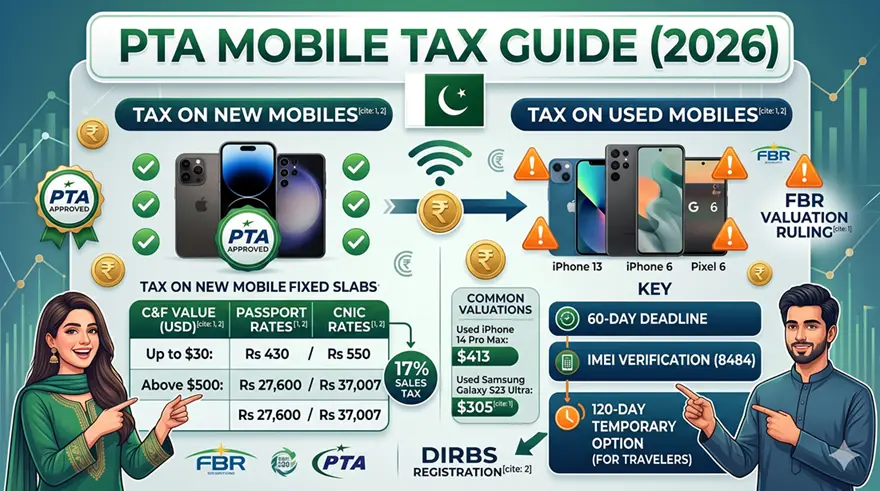
Here is the commonly used tax slab table:
| Mobile C&F Value | Passport Registration | CNIC / Local Registration |
|---|---|---|
| Up to $30 | PKR 430 | PKR 550 |
| Above $30 and up to $100 | PKR 3,200 | PKR 4,323 |
| Above $100 and up to $200 | PKR 9,580 | PKR 11,561 |
| Above $200 and up to $350 | PKR 12,200 + Sales Tax | PKR 14,661 + Sales Tax |
| Above $350 and up to $500 | PKR 17,800 + Sales Tax | PKR 23,420 + Sales Tax |
| Above $500 | PKR 27,600 + Sales Tax | PKR 37,007 + Sales Tax |
So, if your phone is expensive, the tax will also be high.
This is why many people check PTA tax before buying a non-PTA phone. Sometimes a phone may look cheap in the market, but after adding PTA tax, it becomes expensive.
What About Used Mobile Phones?
Used mobile phones are a little different.
A used phone may be old, opened, without box, without charger, or already used in another country. Because of this, Customs cannot always depend only on the invoice given by the importer.
To avoid confusion, Pakistan Customs issues official Valuation Rulings.
A valuation ruling is like an official price list. It tells Customs what value should be used for different used mobile phone models.
For example, if someone imports used iPhones or Samsung phones in commercial quantity, Customs may use the official valuation ruling to decide the phone’s value for tax purposes.
Official Values for Used Phones
According to Valuation Ruling No. 2070/2026, Customs has given standard values for many old and used mobile phones.
This ruling is mainly for old and used phones imported without packing or accessories in commercial quantity.
Here are some examples:
Apple iPhone Used Values
| Used iPhone Model | Customs Value |
|---|---|
| iPhone 15 Pro Max | $505 |
| iPhone 15 Pro | $472 |
| iPhone 14 Pro Max | $413 |
| iPhone 13 Pro Max | $374 |
| iPhone 12 | $156 |
| iPhone 11 | $133 |
Samsung Used Values
| Used Samsung Model | Customs Value |
|---|---|
| Samsung Galaxy S23 Ultra | $305 |
| Samsung Galaxy S22 Ultra 5G | $260 |
| Samsung Galaxy Note 20 Ultra | $145 |
Google Pixel Used Values
| Used Google Pixel Model | Customs Value |
|---|---|
| Google Pixel 9 Pro XL | $348 |
| Google Pixel 8 Pro | $215 |
| Google Pixel 7 | $105 |
OnePlus Used Values
| Used OnePlus Model | Customs Value |
|---|---|
| OnePlus 12 | $211 |
| OnePlus 11 | $121 |
These values help Customs decide which tax bracket applies to a used phone.
For example, if a used phone has a Customs value of more than $500, it will fall into the highest tax bracket. If its value is between $200 and $350, it will fall into that bracket.
Important Rules for Used Phones
There are some important rules for used mobile phones.
First, the phone should usually have been activated before export. In simple words, it should not be a brand-new phone pretending to be used.
Second, if a model is not listed in the valuation ruling, Customs can compare it with similar phones and decide the value.
Third, if the importer gives an invoice showing a higher value than the official ruling, Customs may use the higher value.
So, a person cannot always say, “This phone is used, so its value should be very low.” Customs will check the official value and decide accordingly.
How to Register Your Mobile Phone
Now let’s talk about the actual registration process.
There are three common ways to register a mobile phone in Pakistan.
Method 1: Register Through USSD Code
This is one of the easiest methods.
You can dial:
*8484#
from your mobile phone.
After that, you follow the menu and enter the required details.
You may need to provide:
CNIC number,
passport details, if applicable,
mobile number,
IMEI number,
type of applicant,
travel details, if needed.
To find your phone’s IMEI number, dial:
*#06#
Your phone will show the IMEI number on the screen. If your phone has two SIM slots or one physical SIM and one eSIM, it may have two IMEI numbers. Both should be checked.
After submitting the details, the system may generate a PSID.
PSID means Payment Slip ID. You need this number to pay the tax.
Method 2: Register Through DIRBS Online Portal
You can also register your phone online through the official DIRBS portal.
You need to create an account, select the correct category, and enter your phone details.
The portal may ask whether you are:
an international traveler,
a local applicant,
or another type of applicant.
After you enter your phone IMEI and personal details, the system generates a PSID for payment.
The PSID is usually valid for a limited number of days. If you do not pay within that time, you may need to generate it again.
Method 3: Register Through Mobile Company Franchise
If you do not feel comfortable doing everything yourself, you can visit a mobile company franchise or service center.
For example:
Jazz,
Zong,
Telenor,
Ufone.
Their staff may help you submit the registration request.
This method is useful for people who are not familiar with online forms or who are afraid of entering wrong information.
How to Pay the PTA Mobile Tax
Once the PSID is generated, you can pay the tax through different methods.
Common payment methods include:
mobile banking,
internet banking,
ATM,
bank branch,
1-Link payment system.
After payment, the confirmation is sent to the system. Once everything is approved, your phone status changes and it becomes registered.
After approval, the phone should be able to work permanently on Pakistani mobile networks.
Always Check Both IMEI Numbers
This is very important.
Many modern phones have two IMEI numbers. For example, a phone may have:
one IMEI for physical SIM,
one IMEI for eSIM,
or two IMEIs for dual SIM.
If only one IMEI is registered and the second one is not, then one SIM slot may work and the other may not.
So before buying or registering a phone, always check both IMEIs.
You can check IMEI status by:
sending the IMEI to 8484,
using the PTA device verification system,
or checking through the official PTA/DIRBS method.
Be Careful When Buying a “PTA Approved” Phone
Many sellers write “PTA approved” in their ads. But you should not trust only the words written in the ad.
Before buying the phone, ask the seller for proof.
You should check:
IMEI status,
PTA approval confirmation,
tax payment proof,
PSID record,
whether both IMEIs are approved.
This is especially important when buying used iPhones, Samsung phones, or other expensive imported phones.
Sometimes a phone may be approved temporarily, or only one IMEI may be approved. In such cases, the buyer can face problems later.
So, always check before paying.
New Phone vs Used Phone: What is the Difference for Tax?
For a new imported phone, the tax is usually based on the phone’s value, tax slabs, customs duty, sales tax, and other applicable charges.
For used phones, Customs may use official valuation rulings to decide the value.
So, the basic idea is this:
New phone: value is based on import documents and applicable tax laws.
Used phone: value may be based on official Customs valuation rulings.
Personal phone from abroad: registration may be done through passport or CNIC, depending on the case.
Commercial used phone imports: Customs valuation rulings become very important.